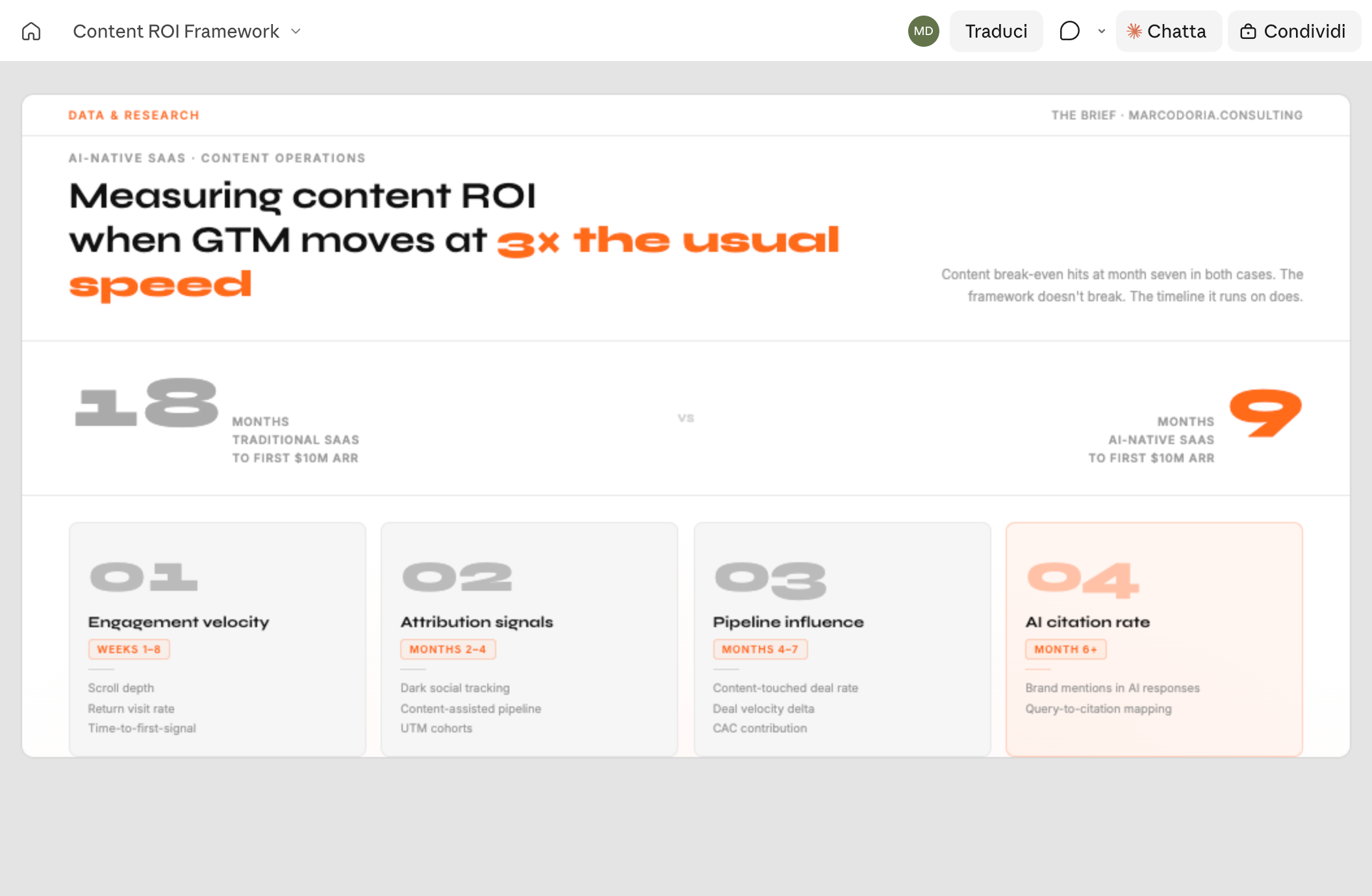
The 7-month content break-even is a real number. So is the 300% ROI at month twelve. Both come from B2B SaaS research that is accurate for companies with 18-month sales cycles and organic traffic that compounds over years. If you are scaling an AI-native SaaS from $1M to $10M ARR in nine months, those numbers are measuring a different business.
The models we use to measure content performance were built for a different growth curve. They assume a 6-12 month content cycle, a long-tail SEO play, a pipeline that moves in quarters. AI-native companies, especially product-led ones, don't operate on that timeline. From what I've seen working with B2B SaaS teams at different stages, they often hit scale in the same window traditional SaaS companies spend iterating on their content strategy. The ROI logic doesn't transfer cleanly.
Content ROI measurement for AI-native SaaS isn't one number, or even one question. It changes depending on where you are in the growth curve, starting with efficiency in the first weeks and ending with strategic positioning at the 6-12 month mark.
Why traditional content ROI frameworks fail for AI-native companies
Traditional content ROI frameworks make a structural assumption: the content production cycle and the revenue cycle run at roughly the same pace. You publish, you wait for organic traffic to build, you attribute conversions, you close the loop at quarter-end. The 7-month break-even figure comes from this model. So does the 844% three-year ROI that gets cited in SaaS content case studies (Averi, 2025). Both numbers are real. Both are accurate for horizontal SaaS with 6-12 month sales cycles. The problem is that they are built on a cadence that AI-native companies have already abandoned. When your trial-to-paid conversion happens in days, the question is not what your three-year ROI looks like. It is what content is helping users reach that first activation event this week, and whether you have the measurement in place to know.
AI-native SaaS companies, particularly those running product-led growth models, compress the traditional content cycle. The sales motion is shorter. The content that drives it is less about ranking for high-intent keywords over 18 months and more about reducing friction at specific activation points right now. A PLG benchmark study found that 91% of B2B SaaS companies are pursuing PLG, but only 34% track content's role in product activation and only 24% use product-qualified leads as a measurement unit (Christian Strunk, 2025). That gap is exactly where the measurement breakdown lives.
When the growth curve is steep enough, the ROI question changes. It stops being "what is the long-term return on our content investment?" and becomes "which content is helping users activate this week, and which is not?" Different questions. Different data, different attribution logic, different reporting cadence.
The 4-layer approach: phase by phase
The model that works for AI-native content ROI treats each growth phase as a distinct layer with its own logic. The layers build on each other, but they don't collapse into a single number until you are well past the $10M ARR threshold.
Layer 1, weeks 1-4: efficiency. Before any revenue signal appears, measure what content costs and what it saves. Time-to-brief, cost per output, throughput compared to pre-AI baseline. This is not ROI yet. It is the foundation that makes ROI measurable later. AI marketing ROI in B2B SaaS can reach 150-350% within 4-8 months (The Hovi, 2025), but that number only becomes legible if you tracked the efficiency baseline from day one.
Layer 2, months 1-3: conversion. The first revenue-adjacent signal: how much content-assisted activation is happening? Free-to-paid conversion rate, product-qualified lead rate, cost per PQL. Early productivity wins from AI-assisted content show up in 30-60 days; meaningful business impact emerges at the 3-6 month mark (Larridin, 2025). The question here is not whether content is paying off. It is whether content is at least not getting in the way.
Layers 1 and 2 together give you the measurement foundation that most teams skip. When you track efficiency from week one and conversion from month one, you build a cohort baseline that becomes the reference point for every attribution decision later. The cost is low at this stage: UTM consistency, a naming convention for content assets, a shared definition of what counts as an activation event. The payoff is that when Layer 3 data starts to appear, you have something to compare it against. Without that baseline, the Layer 3 numbers are directionally useful at best. With it, they start to tell you where the leverage actually is. Most teams that struggle with content attribution at Series A are not missing the analytics tools. They are missing the baseline they should have built in the first 30 days.
Layer 3, months 3-6: revenue attribution. Now you have enough signal to move toward causal claims. Content-influenced pipeline, pipeline velocity by content stage, LTV:CAC from content cohorts. The comparison that becomes possible here: content-originated cohorts versus paid-acquisition cohorts. You can start to see whether content is actually shortening your sales cycle or just accompanying it. Attribution is still partial by design. Content rarely closes a deal on its own, and any model that says it does is overcounting. The signal you're looking for is directional: are cohorts that consumed specific content types converting at higher rates and at lower CAC than cohorts that did not?
Layer 4, months 6-12: strategic advantage. This is where traditional ROI logic finally applies, and where AI-native companies have an edge that most approaches miss: AI search visibility. How often does your content appear in AI-generated answers? What is your organic CAC for segments that come through AI search rather than traditional organic? At this layer, content ROI is not just about pipeline. It is about whether someone building a content budget 18 months from now will find your brand already in the conversation.
Which metrics actually matter at each GTM stage?
The mistake I see most often is not that teams measure the wrong things. They measure the right things at the wrong stage, then conclude the content is not working.
Pre-launch: problem-solution fit resonance, content-to-conversation ratio. Are people responding to the framing, or just clicking? Qualitative, but real signal.
Launch phase, months 0-3: content activation rate (what share of users who engaged with specific content pieces went on to activate), PQL rate, cost per PQL. UTM structure at this stage is not optional. It is the only way to close the attribution loop six months later when you are trying to explain pipeline.
Scaling phase, months 3-6: pipeline velocity by content stage (top, middle, bottom), LTV:CAC from content-originated cohorts versus paid-acquisition cohorts.
One number worth tracking from month one that most teams skip: first-touch to last-touch gap. The difference between where a customer first encountered your content and what they consumed before converting tells you more about the funnel than any single metric by itself.
Implementation priorities: where to start
The measurement infrastructure matters more than the measurement strategy. Three things need to be in place before any of this works.
UTM taxonomy and naming convention. Consistent from day one. Change it mid-year and you lose the ability to do cohort analysis. Decide on a structure, document it, enforce it. Not glamorous. But it is the difference between having data and having numbers.
Reporting cadence matched to the decision it serves. Weekly covers activation metrics and throughput, where you need fast signal to adjust. Monthly is where you look at conversion rates and pipeline velocity. Quarterly is for cohort LTV:CAC and a positioning review: is the whole system pointing in the right direction? Running everything at the same frequency means you are either too slow on tactical calls or drowning in strategic noise.
Separate AI-assisted from human content in attribution. Specific to AI-native teams, and it matters. AI-assisted content has a different cost structure, different production timeline, and often a different quality ceiling. Without that separation in your attribution model, you cannot tell whether AI is adding ROI or just adding volume.
Working on publisher-side metrics for four years, the discipline I carried over was simple: each piece either paid for its place or it didn't. Total sessions were context, not signal. The content teams that build that discipline before $10M ARR arrive at scale with a measurement system that works. The ones that defer it find themselves with years of data that cannot tell them which pieces actually pulled weight.